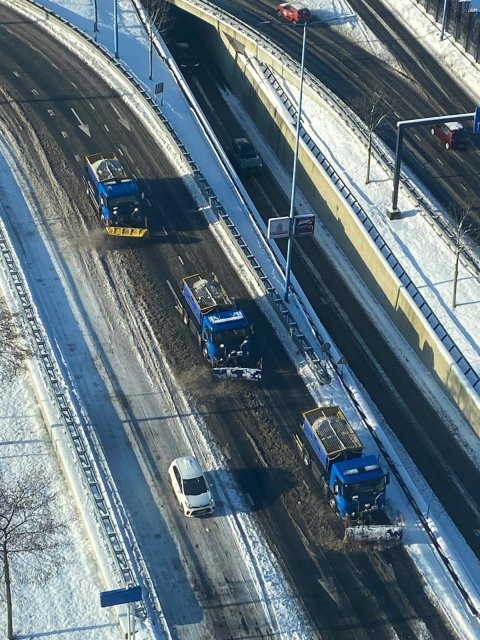
Information about slippery conditions in Zoetermeer
We are receiving many questions, reports, and comments about ice control. In this news item, we provide up-to-date information about ice control and answer a number of frequently asked questions. The information is updated regularly. So keep an eye on this item for news.
Current situation
January 8, 2026, 7:08 p.m.
- Municipality closes Willem Alexanderplantsoen sports hall, De Veur swimming pool, and Atrium van Castellum as a precautionary measure
- Side streets, residential streets, and bike paths in particular are currently more slippery than in recent days. We cannot use large snow plows here, but we are deploying small vehicles to clear these roads. Please be careful when going outside.
- Main roads and streets that are almost clean or black are easily passable. The first thaw has set in and the road surface temperature is around 1°C.
- The thaw will continue for a while, but from Saturday at 4 p.m. there is a chance of frost and precipitation again. A gritting team is on standby to respond if necessary.
When will gritting/snow clearing take place?
Based on weather information, contact with a meteorologist (in some cases), and our own observations, we determine whether gritting is necessary. Gritting takes place early in the morning or late in the evening, usually before or after rush hour. However, in recent days there has been so much snow that gritting and snow clearing took place from 4 a.m. to 11 p.m. You can find the gritting routes and gritting times at zoetermeer.nl/gladheid.
Why are the neighborhoods, bike paths, and sidewalks not being gritted and cleared?
To keep the city accessible, the first priority is the main roads, access roads, and main cycle paths. We have to complete the gritting routes in about three hours, for example, so that the salt is on the road before the morning rush hour and is properly worked in. We have enough gritting trucks for this method. If we include neighborhoods and bike paths, the routes become too long and more gritting trucks are needed. All municipalities in the Netherlands adhere to this method.
In addition, the gritting trucks are too large and the snow plows too wide for many side streets. If we were to drive here anyway, there would be a high risk of damage to residents' cars. That is why the streets in the neighborhood and the smaller bike paths are usually not gritted. At the moment, the few smaller vehicles we have are being used for this purpose. Sidewalks are never gritted or cleared of snow because our vehicles cannot access them.
Why do the loops in Rokkeveen and Maximaplein remain so slippery?
The loop in Rokkeveen and Maximaplein in Oosterheem are well-known locations where slippery conditions are more difficult to combat. Both locations are elevated, which means that the wind has free rein and the temperature of the road remains colder. Parts of these locations also remain in the shade, preventing the snow from melting in the sun. Because the loop and Maximaplein are more slippery, most motorists drive more slowly. This is good for safety, but it also means that it takes longer for the salt to be worked into the road surface and do its job. So take extra care when driving here.
What can you do yourself?
You can clear the snow from the sidewalk in front of your door and, if you have road salt, you can also spread it here. If everyone does this, the neighborhoods will become more accessible again. Road salt is available at hardware stores.
Where can you find more information?
For the latest updates, keep an eye on this news item. If you would like to know more about gritting operations and gritting routes, please visit www.zoetermeer.nl/gladheid.