
Asian hornet
The Asian hornet (Vespa velutina) is spreading in the Netherlands. This large wasp preys on pollinating insects, such as honeybees, wild bees, bumblebees, and butterflies. In countries like Portugal, Spain, France, and Belgium, measures are already being taken to prevent damage to agriculture and the natural environment. In the Netherlands, too, we are exploring better ways to control this invasive species.
A sting from an Asian hornet is painful and can be dangerous. Doctors warn of allergic reactions; the hornet can even spray a toxic substance at an attacker. The problem is that the Asian hornet is larger than a common wasp and can inject more venom. If their nest is disturbed, Asian hornets can attack en masse. A person can then sustain multiple stings, which is dangerous.
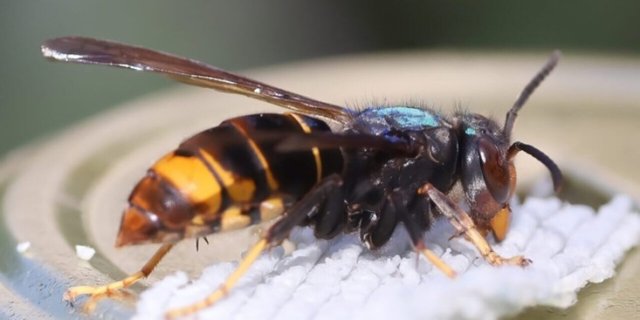
Features
The Asian hornet—slightly smaller than the European hornet—can be recognized by its black thorax and abdomen, which feature a single broad yellow band, and its striking yellow legs.
The Asian hornet builds three types of nests in a single year. Between March and May, after emerging from hibernation, the queen begins building a small embryonic nest about the size of an apple. These nests are often found in birdhouses, sheds, carports, and other sheltered locations.
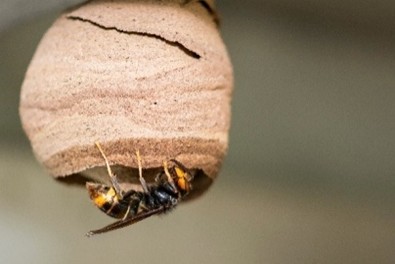
Starting in late May, the queen moves to a spring nest that can grow as large as a soccer ball. These nests can be found in hedges, low shrubs, or on the ground. The risk of disturbing a nest is highest during this period. Starting in August, the hornets move to summer nests the size of a medicine ball, high up in the trees. They are less dangerous at this stage, but these nests produce hundreds of queens who will try to build their own nests the following year.
The nests look like paper balloons. The population is growing explosively, and to prevent it from growing even further, all nests must be removed. By 2025, 7,500 nests had already been reported in the Netherlands—five times as many as the previous year. Each nest can hatch up to 3,000 hornet eggs.
Increase in South Holland
Since 2018, hornet nests have been found in Limburg, North Brabant, and Zeeland. In recent years, an increasing number of nests have been found north of the major rivers, in South Holland, Utrecht, and Gelderland. This means that the nuisance is spreading northward. Last year, more than 750 nests were found throughout South Holland, which was five times as many as in the previous year.
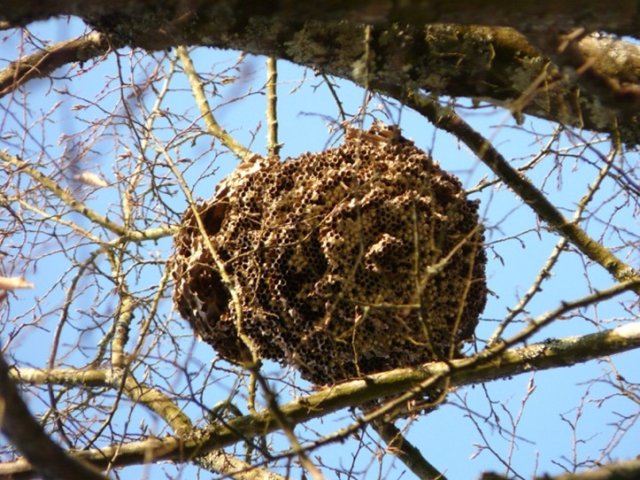
Help look for them, but don't remove them yourself
Help us locate Asian hornet nests. In the spring, check sheds, birdhouses, under eaves, and other sheltered spots. Starting in June, be careful when trimming hedges, and check low-lying shrubs and the ground. Starting in August, you can find nests high up in trees.
Do not remove the nests yourself. Note the location (take a photo) and contact an expert who can safely remove the nest. Beekeepers from local beekeeping associations are happy to help; after all, it is their honeybees that are at great risk.
Report the nest
If you see a nest of Asian hornets, please report it to the municipality, record the nest’s location with a clear photo via waarneming.nl/go/vespa-velutina, and report it to the hotline: