
Japanese knotweed
Japanese knotweed is an invasive plant species native to East Asia, but it has since spread across large parts of Europe and North America. Japanese knotweed spreads rapidly. It is not without reason that it is considered one of the most aggressive invasive species. Due to its vigorous growth, Japanese knotweed crowds out native plant species, and its strong rhizomes and stems can cause damage to structures, pipes, and roads. Japanese knotweed grows in a wide variety of locations, such as railroad embankments, vacant lots, road shoulders, river groins, forest edges, and stream banks.
How can I identify Japanese knotweed?
Japanese knotweed (Reynoutria japonica, formerly Fallopia japonica) is a perennial plant that can grow up to 4 meters tall. The plant can be recognized by its stems, which somewhat resemble those of bamboo: they are hollow inside, consist of compartments, and are green with reddish spots. The plant has large heart-shaped leaves and blooms with creamy white flowers in August and September. By winter, the above-ground parts of the plant die back, while the underground rhizomes overwinter.
The underground rhizomes are highly branched and are found at a depth of up to 80–100 cm below the surface, though they can also occur deeper. In the spring, numerous stems grow densely from the “nodes” on the rhizomes within a short period of time. Nodes are also present at the junction between two stem segments, from which new side shoots with leaves emerge. The name "knotweed" refers to the many nodes the plant has. The plant spreads via pieces of rhizomes and stems. Once established, the plant is difficult to eradicate.
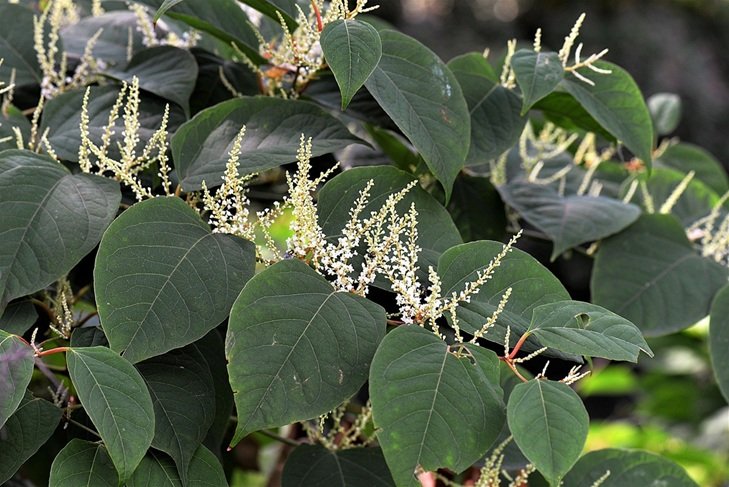
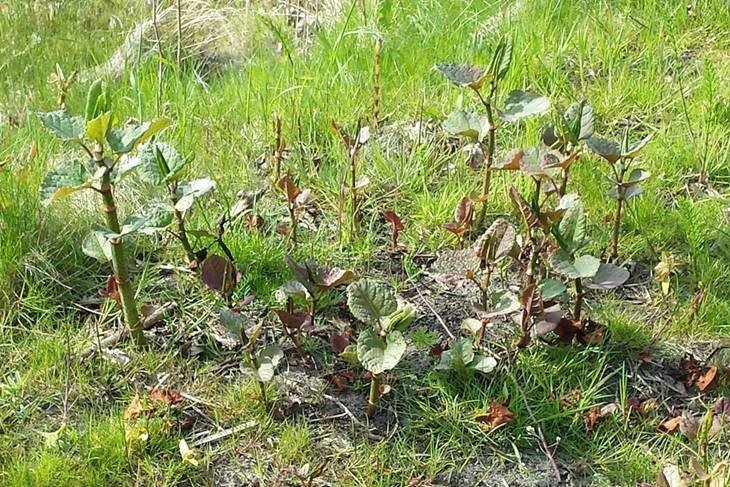
Knotweed on private property
Is there Japanese knotweed on your property or in your garden? If so, it’s best to pull out the stems or dig up the plant, roots and all. Try to remove all root remnants, as a new plant can quickly grow back otherwise. Pulling or digging up the plant is effective, but this must be done repeatedly before the knotweed infestation is completely eradicated. Also inform your neighbors, as the plant can also appear in adjacent gardens.
- Pull it out of the ground, preferably with the root still attached.
- Carefully collect all the waste (stems and roots) so that nothing is left behind.
- Put everything in a sturdy, sealable trash bag.
- Put the trash bag in the regular trash. Definitely not on a compost pile or in the green bin!
- The plant waste is then disposed of along with the household trash.
- Clean your gardening tools thoroughly and remove all traces of Japanese knotweed.
- Repeat the process of pulling up the plant regularly. This will wear down the Japanese knotweed and stop its growth.
What does the municipality do?
The municipality of Zoetermeer has begun tackling Japanese knotweed at various locations throughout the city. For now, the focus is on locations where:
- The plant hinders the daily use or management of public spaces.
- The plant poses an immediate threat to infrastructure, such as roads, cables, and pipelines.
Report locations?
Residents of the municipality of Zoetermeer can report locations where Japanese knotweed is present. An expert will verify the location and the urgency of the report. If the knotweed is growing in a public space, a specialized contractor can assess the situation and remove it where possible. In addition, your report will be recorded on a map showing locations where Japanese knotweed is present in the city. You can submit your report via the Buitenbeter app or by calling 14 079.
More information
More information about knotweed, how to identify it, and tips on controlling it: